
Reform The Washington Post

This week, Jeff Bezos fired hundreds of people at The Washington Post. Liberals are taking it as you would expect—I call it hysterical histrionics. Here’s The Atlantic, which burns the money of Steve Jobs’s widow, deploring the reduction in the burning of Bezos’s money at the Post. I notice they aren’t demanding the true rights of the woke-liberal alliance, that the Bezos ex-wife buy The Post!
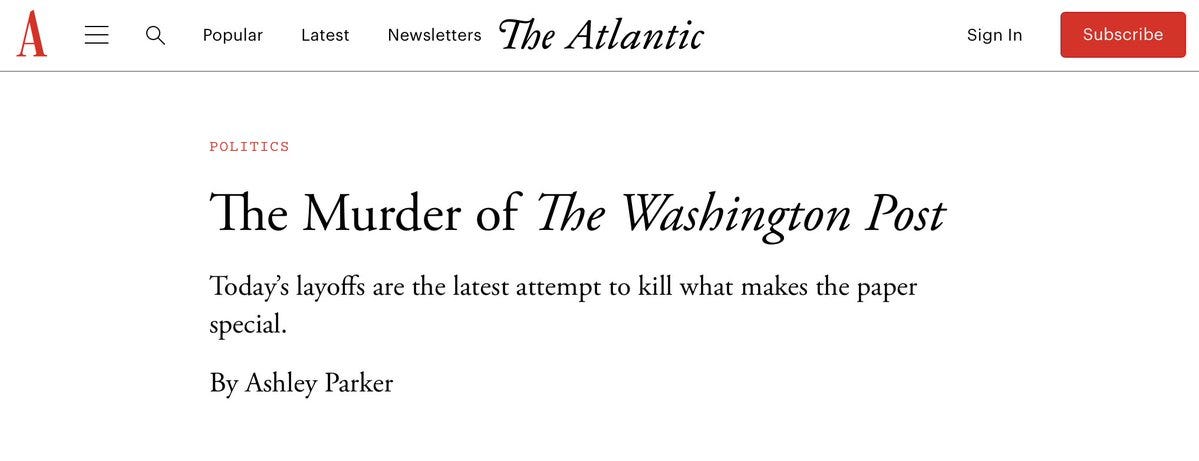
People on the right, contrariwise, are enjoying the spectacle of a malfunctioning propaganda machine collapsing, the minor spectacle of justice, the firing of so many impudent clowns. (That seems like a distraction from more functional propaganda machines…) For my part, I think the Washington Post could be saved without too much trouble.
First, since so many crazy things have happened that cannot be changed in the 13 years since Bezos bought The Post, the brand of The Post should be reinterpreted as a lightning rod. Drop the liberal demand for respectability, not to say glamour, & especially drop the tendency to hysteria in storytelling, in favor of getting as many explosive political stories as you can. You'll win everyone over because politics is the only thing that matters now in America, yet nobody is willing to do political journalism. The major editorial question is how to align an elite pursuit like journalism with popular opinion, what the vulgar call “60-40 issues” or more.
Next, exploit The Post’s only real advantage, that it's the major trade paper in a company town. In D.C., the political really is personal. In everything from the gossip column to leveraging access to the state to reveal what's coming at the whole world—who you talk to & how you phrase things makes all the difference. You can claim the whole political domain with a brand like The Post’s & relentless pursuit of major stories, whether because they hold the nation’s attention on account of political conflict (after all, the mass-media seems to survive only because of Trump) or because the stories are buried. You can do national stories on the basis of D.C. insider information, since you can connect them to national institutions like the parties or to industries of national importance. You can be arbiter of the competing talent among the young; you can help define the reputations of the old figures.
Finally, the unique power of The Post is actually enclosed in the Watergate story: A deep state scam was sold to America as a moral crusade, taking down a president. You can see where the emotional power is: Everyone in D.C. knows the meaning of betrayal, if nothing else. We say it's a transactional town, but it's worse than that, it's cynical. America isn't cynical, contrariwise. So The Post has the unique opportunity to avoid liberal histrionics while humiliating the conservative ignorance or helplessness about politics & media. In short, The Post should be elite. One can understand the Republican Party simply by noticing that conservatism is neither capable of running a good political journal in the national capital, nor even ambitious enough to try. The Post could easily win over the party. Nor could liberals afford to ignore it, since they depend on what’s going on in D.C., too.
Jeff Bezos personally has the unique opportunity to assert independence by remaking The Post. He's invulnerable politically & financially, if anyone is, but he has no dignity, he can't claim he's stewarding America's most important political paper; he's more like an absentee landlord whose squatters rights' tenants hate his guts & are constantly running him down. Nobody in America talks politics from a position of strength. Bezos now can do that.